On 1/1/2017, buyers get a bump to their purchase power when they finance a home loan. The conventional (AKA "conforming") loan limit increases to $424,100 (from $417K; min 3% down required) and the FHA loan limit increases to $275,665 (from $271,050; min 3.5% down required).
View MoreSearch Central Phoenix & Scottsdale Properties
What's Happening in Phoenix, Scottsdale & Paradise Valley Real Estate?
Real estate in the Valley of the Sun is dynamic! Miss a minute, miss a lot. Check back regularly to stay on the top of the latest affecting Metro Phoenix, including Phoenix, Scottsdale & Paradise Valley. Can't find what you're looking for here? Call, text or email me. I’ll help you find what you need.
Knowledge is power!
Dec. 18, 2016
How are Contemporary and Modern Architecture Different?
Do you know the difference between "contemporary" and "modern" architecture? Which principles and/or elements specifically make them different??
I thought I knew. We see new styles of architecture all around Phoenix & Scottsdale as new residents with more appreciation and affinity for either move to our area from other metropolitan cities across the US, Europe & beyond. Places like Desert Mountain & parts of North Central Phoenix, with its neat rows of Ralph Haver homes, have drawn reproductions of varying elements of both to Arcadia, Paradise Valley, McCormick Ranch and to even master-planned communities like Desert Ridge & DC Ranch.
My own listing in McCormick Ranch (see it here), stands out from it's mostly Spanish-style neighbors on the block:
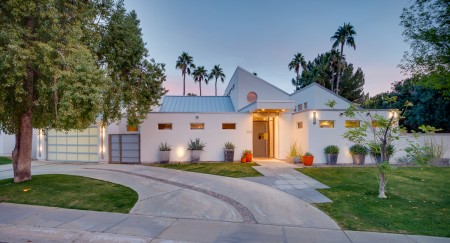 MLS# 5390423
Dec. 15, 2016
Trend Alert: Disappearing Property Gates
"Security" is a big buzz word these days...
I of all people am acutely aware of how much security impacts us. Even though you're probably thinking about your technology, I'm a Realtor®. I'm talking about security at your home.
I absolutely LOVE this concept- form & function to keep homes secure! We all want to keep our homes safe and there are a million ways to do it. Let's just say that some aren't as aesthetically pleasing as others... However, my hat's off to Fancy Fence out of Poland. I think they nailed it...
We should all aspire to be as stylish as the Europeans, but realistically this is probably not a solution for most styles of architecture. BUT, if you've got anything in the spectrum of contemporary or modern architecture, you're covered!
Even though it's not available in the US yet, I give it a year before we start seeing it in the 'burbs or LA, SF, NY, DC or Miami. Someone's going to "have to have it" and the holidays are around the corner... :)
Related info:
Top 5 Features of Metro Phoenix Homes Over $500K Sold Recently
Oct. 11, 2016
Real Estate Opportunities in Metro Phoenix- October 2016
There are opportunities in EVERY market.
Think everyone lost during the Great Recession? Think again. Hedge funds and small-budget investors made out like bandits, even as many people lost the shirts off their backs. That said, there are opportunities to be had in the market today too. As of October 1, 2016, here's where the opportunities abound for sellers and buyers alike in Metro Phoenix.
Take a look at these fairly simple charts published by the Cromford Report on 10/2 (YoY Active Single-family Listings) & 10/3 (YoY Pricing Strength):
[gallery columns="1" link="file" size="medium" ids="5395,5394"]
If I match the colors of these 2 charts by lining up the price ranges and look at them from a seller's perspective, a clearer picture starts to emerge... Green = Sellers Rejoice; Yellow = Caution Sellers; Red = Beware Sellers; White = Neutral/normal. If we line up the colors and look for matches...
[gallery columns="2" link="file" size="medium" ids="5396,5397"]
There are Opportunities for:
- Sellers with homes with homes under $200K. There aren't enough homes like these to go around (Low inventory + Pricing Growth = Good potential for Sales & Profits)
- Sellers from $275-400K. Inventory isn't growing in a market that was already short on supply & pricing is fairly stable. (Low inventory + Stable Pricing = Good Potential for Demand Increase)
- Buyers seeking homes from$1.5-2.0M. There are TONS of options AND pricing is on the down swing. (High Inventory + Pricing Decline = LOTS of choice & Lower Prices)
- Sellers with homes worth $2M-3M. Even though there's plenty of supply, the pricing is strong and seemingly still growing (for now). From $2-3M, there is only a modest increase in listings and a 10% jump in pricing. (Flat Inventory + Pricing Growth = Potential for Profits, IF demand stays stable)
There may be Opportunities for:
- Buyers seeking homes from $200-275K. Inventory is growing (more choice) and though pricing is up a little, it's well within the historical range of "normal" (0-4%).
- Buyers seeing homes from$400-500K. Inventory is substantially up and pricing is flat to slightly positive.
- Buyers seeking homes from $600K-1M. Inventory is growing, but pricing strength is flat to negative. If we don't see some slowing in listing volume, that segment will end up out of balance.
- Buyers seeking "undesirable" homes. You know what I'm talking about, the ones in major disrepair, with significant deferred maintenance or simply just extremely dated (not even close to being featured on HGTV as an "after"). "One man's trash is another man's treasure...", but only if the buyer has an appetite (or stomach) for it. I've seen some pretty phenomenal deals out there that fit the bill over the last 6 months.
How to Cash In
To spell it out more clearly, read (if you haven't already) a few blogs I wrote earlier this year:
- Top 5 Features of Metro Phoenix Homes Over $500K
- Buyer Pep Talk: Don't focus on the wrong things!
- 8 "Must Do's" to Sell Your Home Now
- Buying a home? Take notes. Then compare them
If you're buying a home using financing, check with your lender and make sure your pre-qualification letter is ready. This is a prequal letter- not the goofy one that your bank sends on their letter head. The one you need looks like this:
 REQUIRED: AAR Buyer Pre-qualification Form
Sellers, I can't stress enough that assuming "my house is fine as it is" rarely works out in your favor with most buyers. This is especially true if you're in a price range with lots of stiff competition, unless your home has very similar attributes of other recently sold homes and you plan to list at about the same price point. You need to be really honest with yourself and no- listing at 10% above the most comparable home sale doesn't count. Go see some of the competition before you assume "we're good!"
What to Expect
Expect more of the same. Remember these charts I posted earlier this year?


Even though the current inventory growth is pretty cyclical, we started the year with inventory out of balance with supply at several price points. Although we had a strong spring & summer, it appears the market is headed back to (or never left) unbalance in some of those price ranges. As of 9/2/16, here's what things look like:

Chart, numbers, blah, blah, blah. Let me cut to the chase: the price ranges that have red & blue bars (pending & sold listings) as tall as the green ones (active listings) are good for sellers. It's pretty solid up to about $250K. The price ranges with tall green bars and very short red or blue bars (or virtually no bars at all), are so good for sellers.
Above $500K, there are substantially more active listings than pending and sold listings. The chart gives a visual of what I said, though it's not as easy to see above $1M because the numbers are small and not well represented on the chart.
The Cromford Report "Market Summary" on 10/2/16 reiterated a lot of what I wrote above and have been saying for roughly the last year. Here are a few snippets:
- "This is the time of year when supply becomes more freely available and we need to watch carefully how the supply builds for the different price ranges."
- "Overall the market is firmly in the seller's control except for the luxury market and above $1 million, location and date built (or remodeled) become the key issues."
- "A strong trend is emerging which favors new homes over re-sales. To a lesser extend, smaller attached homes are growing market share at the expensive of larger detached homes. Convenience and style are gradually becoming more important than living space and privacy. This reflects the gain in influence of millennials and the slowly declining importance of baby boomers. The latter are impacting the market by downsizing and retirement lifestyle decisions."
- "We have a healthy market with low distress levels and gradual improvement in access to financing. Unless there is a sudden reduction in demand, perhaps due to big changes in population growth rates, 2017 is likely to continue to reflect these trends."
Consider yourself "informed"
Please reach out to me with any questions or if you're ready to take the plunge- sell or buy. I'm here to help!
Related info:
Endangered Species: Cheap Houses in Metro Phoenix
Oct. 4, 2016
Endangered Species: Cheap Houses in Metro Phoenix
Looking for a cheap house to buy in Metro Phoenix? Better get one while you can...
 10/1/16- Active Listings by Price Range In Metro Phoenix
There are thousands of homes to buy, but the days of $50K, $60K, or $75K homes are all but gone. In fact, as the Metro Phoenix real estate continues the path to full recovery, listing counts are declining for all segments under$175K. Why? Values are increasing. There's aren't many really inexpensive homes left. Look at the chart put out by the Cromford Report on 10/2/16. As it is, our median home price for the metro area (all areas, all types of homes) has hovered at the $230K mark for the last 3 months. That median price was $142K in 2012 and bottomed at $108,100 in the middle of 2011. We've come a long way...
Interest rates are still really low- lower than they were at the peak of the housing crisis.
Interest rates right around that time in 2011 for a conventional loan with 20% down were 4.125% and about 4.75% on an FHA loan with 3.5% down. Today, that interest rate for same loan amount roughly 3.5% for conventional and about 4.125% for FHA. What does that look like on paper?
In summer of 2011, a buyer buying a home at the median sale price would have paid between $418-544 for a mortgage (depending on their credit and down payment amount).
[gallery columns="2" link="file" size="medium" ids="5385,5386"]
A mere 5 years later, in summer of 2016, a buyer buying a home at the median home price would have paid almost double- between $826-1,075 for a mortgage (depending on their credit and down payment amount), even with lower interest rates.
[gallery link="file" columns="2" size="medium" ids="5387,5388"]
In case you're wondering about the house...
The average size home went from 1,944SF in 2011 to 2,000 in 2016. That equates to a 56SF space- maybe a 5x10 closet or nook?
 Metro Phoenix Historical Average Home Size
The bottom line...
If you want to own a home someday, you have to start by getting your foot in the door. Interest rates help, but rising home prices are harder to combat. And for all the naysayers who keep talking about "the bubble on the horizon". Keep dreaming! I'll address that in another post someday, but the fundamentals are pretty solid.
 Percentage of Metro Phoenix Homes Purchased with Cash
All this said, if you really want to be a homeowner and quit paying someone else's mortgage, have a stable place to live where your monthly payment won't have wild increases, be able to paint your walls without asking permission (well, at least on the inside) and start building a nest egg, you have to figure out what you can comfortably afford and find a way to make a down payment. There are lots of ways to do it, no matter how difficult, impossible, no chance in "you know where" it seems. Where there's a will, there's a way... I can help. All you need to do is call, text or email me to get started. ;)
Related Articles:
September 2016 Phoenix Market Summary
Sept. 27, 2016
September 2016 Phoenix Market Summary
The real estate market is stable in Phoenix & Scottsdale.
Home sales in Metro Phoenix under $300K are very strong. Above that, things are improving in spots. The overall market favors sellers, but that's more to do with supply and demand than anything else. We started to run short on inventory across the board, but that's changing now too. There are lots of new trends emerging.
Here are the most notable shifts I see in our market:
- YoY sales are increasing in the middle price ranges of our market. This is likely due to prices also increasing. As sales vanish from some segments, they reappear in other segments.

- Inventory is increasing. It's sill tight in the most desirable areas- specifically 85251 (half of Arcadia Proper & Old Town Scottsdale) & 85018 the other half of Arcadia and a good portion of Arcadia "Lite". Listing counts usually drops during summer, but come fall we start to see new listings come to market. This is welcome relief for a lot of these buyers. In other areas where homes are closer to the median sales price for Metro Phoenix (low $200,000s), i.e. SW Valley (Tolleson, Laveen, S. Phoenix), inventory also has been tight, but we're seeing a few more homes come on the market.

- Contracts are increasing. The market jumped about a month ago after our seasonal summer lull and sellers across the valley got a lot of encouragement. At the opposite end of the spectrum (Paradise Valley, North Scottsdale), many high end homes $600K+ that were sitting collecting dust all year are selling, and many others were recently cancelled or expired. Many had BIG price reductions. That reduced supply to get in line with demand... now cyclically, we're seeing new listings again. Just when these sellers getting who've been hanging thought they'd get some breathing room, a fresh new listings are popping up to compete with. However, even this increase may petering a bit.

- Rentals are still hot, but not like they were. There are a lot of new apartments communities being developed to ease the multi-family housing shortage that persisted over the last several years. As they come to market, older properties that aren't as well-maintained or in desirable areas are starting to feel the heat. Houses for rent are faring a little better, but are still out of reach for those in the lower price ranges.
In general, there are some overall trends driving the shifts above.
- On Friday I posted on Instagram & Facebook about trends that economist, Mike Orr (Cromford Report), has been starting to share more loudly & persistently. For months, he's been generating reports and sharing stats that Arizona's population is aging. The median age in Maricopa county jumped from 34.7 (2010) to 36.1 (2015). Unchanged, this one trend WILL change our housing market significantly over the next 5-10 years and beyond.
 Source: Cromford Report
 - The Baby Boomers are one of 2 generations that comprise a large portion of the home-buying population today in our area. They're seeking access to lifestyle amenities (airports, recreation, shopping, dining, healthcare, etc).
- The Millenials are another big buyer segment. They're migrating towards 2 things: jobs & the same stuff the boomers want- access to lifestyle amenities (airports, recreation, shopping, dining, etc.). Here's where the jobs are: http://www.azcentral.com/story/money/business/jobs/2016/09/09/arizona-companies-hiring-100-more-september/89976120/
- Those wish list items each generation is seeking all tend to be interconnected. The biggest hotbeds of activity are centered around economic development, which is expanding around Downtown Phoenix, N.Central Phoenix, Arcadia/Camelback Corridor, Old Town Scottsdale, Tempe, Chandler, Gilbert & Glendale. Additionally, these areas generally have decent freeway infrastructure and things to keep people occupied, outside of working. We'll call it the "fun stuff".
- The Boomers arguably have the most spending power, but the Millenials have force "en masse" because their collective dollars add up. These days, both groups tend to favor an "unattached" lifestyle, desire a smaller home footprint & value location over lots of "stuff".
- If you put a bullseye on the center of Metro Phoenix, the middle is kind of "where it's at". There are new restaurants, businesses, shops, housing, schools, etc- all the good stuff, most people want within proximity of their home. The outskirts also draw buyers, but as people migrate in and out of our state, they'd better have lots to offer in lieu of convenience so people will want to be there (Big shout out to Chandler & Gilbert here!).
What does all of this mean to me, Camille??
Consider how these trends will impact YOU specifically in the near future... Going back to the 2 maps I shared, did you notice quadrants with the most houses/sellers weren't completely aligned to where the contracts/buyers are needed most? That said...
Buyers:
If location matters to you (and it should), figure out where you want to be and become intimately familiar with the real estate market there. If you hate long commutes and plan to be at the same job for a while, figure out whether now is the time to jump in or sit out and wait to get your ducks in a row.
If you're under 35 and don't own a home, you might want to reconsider that conclusion. I've got something to share with you:

If you don't want to be dependent on anyone and you're not saving, contributing to a 401K or some other stable investments, it's time to think about owning a home... Interest rates are low. Young buyers today are lucky! I paid 6.5% interest for my 1st mortgage. Fourteen years later, I'm in the process of refinancing into a 3.625% interest rate. I'll be paying about $500 more per month to OWN a home roughly 3 times the size of the last home I rented in LA 15 years ago!
I'll write another blog about how much the net worth of some of my younger clients has increased in the last 5-7 years with real estate alone... There's no voodoo magic. Instead of paying someone else's mortgage (rent) and improving their bottom line, pay your own. Improve your bottom line. Just sayin'...
Sellers:
How does what you've got to offer compete to what's out there for other buyers to see? If you don't know the answer to that question beyond what you've seen in MLS in the last few months, it's time to get real and figure it out. If you live on the outskirts of town and have a home that isn't in an area desirable to the largest segments of buyers and/or your home can't physically accommodate the needs and whims of these buyers, how are you going to position your home?
If your home is not on the market yet, but know you know that it's not in great shape or doesn't offer some hook to some buyer, how are you going to hook a buyer? If your house is on the market today and not much is happening, but you've watched competing listings around you get snapped up, what is your unique proposition to get buyers to see it? Or worse, if you've kept pace with the same bunch for a long time and none of them are moving either, what are you going to do to stand away from the crowd? Price is one, but there are other creative options...
I know it's a lot to take in, but of all the info I've shared with you, find what's relevant to your situation and factor it into your plans. If you need more info, say so!
I've got a lot of answers to help both buyers and sellers. Call or text me when you're ready for me to position you for success!
Related articles:
Home Inspections: What Every Buyer Needs to Know
Top 5 Features of Metro Phoenix Homes Over $500K Sold Recently
Aug. 3, 2016
Home Inspections: What Every Buyer Needs to Know
 Most buyers have an “inspection period” or the right to perform “due diligence” prior to completing a home purchase. If you are spending a lot of money, shouldn't you know what you’re getting?
View More

June 28, 2016
VIDEO: Monsoon '16 Maintenance Tips & the "Brexit" Effect on Phoenix Real Estate
Don't forget to do your "Monsoon Season" maintenance! Also, find out how "Brexit" is impacting Phoenix/Scottsdale Real Estate. Here's what you need to know in ~2min.
Stay cool & have a Happy 4th!!
Related Info:
Top 5 Features of Metro Phoenix Homes Over $500K Sold Recently
Renting a House in Metro Phoenix: what you need to know
June 23, 2016
Top 5 Features of Metro Phoenix Homes Over $500K Sold Recently
There are a lot of luxury homes for sale in the Phoenix/Scottsdale, Arizona.
For most of spring 2016, I've talked about how half of the market is pretty hot and the other half, not so much. Homes under $250K are a hot ticket. From $250K-$500, the market fluctuates back and forth between buyers and sellers, but is closer to balanced. Above $500K, it's not a pretty story for many sellers.
As of 5/31/16, single-family homes (SFR) in Maricopa County over $500K represented 35% of all active listings, but only 10% of the homes that actually sold in May.
Ouch! However that sobering statistic doesn't discourage other sellers with homes above $500K from listing their homes for sale too. There are many reasons they want or need to sell.
- Canadians are cashing in on properties acquired during the recession while the US$ is stronger than the CA$
- Empty-nesters/Baby Boomers are downsizing
- Sellers are moving on from 2nd/vacation homes they no longer need
- The "other" usual reasons:
- relocation for work,
- major life changes, like divorce, death, growing family, etc.
Buyer demand is fairly static, but the sheer number of listed homes puts downward pressure on pricing. In theory, the laws of supply and demand should force sellers to reduce their price or delay selling, but that's not the case. Many are content to sit and wait. I have and had a few higher end sales/listings myself this spring and have seen the best and worst of this market segment.
I wanted to know what was driving buyers to or from luxury homes on the market today.
I focused primarily on what I call "The Core" of the Metro area (Thompson Peak Pkwy south to the US-60 FWY & from the I-17FWY east to Pima Rd.), where I work most. Specifically, I looked at SFR sales over $500K that sold within the last 30 days AND spent no more than 30 days on the market. 182 home sold within 60 days of 6/20/16, but I wanted to know why buyers wanted THESE homes so bad that they sold in less than 30 days and a few for full or over asking price.

I analyzed these homes for the features in a home buyers tell me they want and the ones to which they all gravitate. They included:
- Neutral paint (white, linen or gray)- Yes, buyers will actually specify that they want this more contemporary or modern color palette that presents itself as more "light and bright" than the "desert tans" of the last decade or so.
- Modern or professionally staged styling- Even though furniture rarely sells with a home, buyers frequently comment that a seller's furniture and/or decor are "awful!" The listing photos often turn them off before they actually get inside!
- A great room floor plan- all one open kitchen, living, dining space as opposed to formal, individual areas.
- Wood or "wood tile" floors- I'd like to make the distinction that though most buyers like the look of wood (engineered or solid), they all tend not to embrace laminate wood floors like the other 2 options. Tile (natural stone, porcelain, ceramic or otherwise) has it's share of maintenance-anyone have dirty grout lines?? Who loves carpet when living in the dusty desert??
- Recessed lights- no- buyer I've worked with has specifically requested them, but in my experience, buyers sure seem to like them a lot. My theory? They're bright and give a modern feel.
- A good school district- keeps values strong; again this both subjective and relative. I tried to stick with schools/districts that agents actively market as a feature like "3-Cs" (Scottsdale USD), "Madison [Elementary] Schools" (N. Central Phoenix), etc.
- A large lot- by large, I mean large relative to the immediate area. I do not expect anyone buying in Arcadia Lite, Old Town Scottsdale or the historic districts of Phoenix, (i.e. Willo or Encanto), to have a burning need for an acre lot.
- A remodeled kitchen
- A remodeled bath(s)
- Single-level- whole house all on one floor
- No interior steps- not the same as single-level. There may be transitions between minor levels if you have a hillside home and many homes in the 80s have sunken areas like living rooms or bedroom sitting areas. Everyone's favorite is usually the sunken fireplace conversation pits...
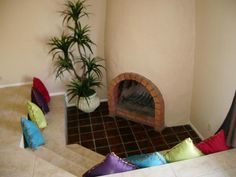
- A private pool- it sure is nice not to have to pack up your stuff and go anywhere to swim on a hot day...
- Views- city, mountain, golf course, etc.
- A newer home- less than 10 years; for the record "new" is a relative term. I went to a university founded in 1689, was married in a church built in the 1800s. However, since AZ wasn't even a state until 1922 and most of our area's development occurred in the 1950s or later, most people think everything here is new. And what's "old" is more often dictated by decor than it is by architecture. All that said, people in AZ love newly built homes, especially when they come from places like where I grew up in the Northeast.
[gallery ids="5164,4911,4905,4901,4768,4741,4617,3917,2760,4599,2901,4732,4771,4951,5170"]
Did any of the above criteria correlate to what was actually selling? Here's what I found out:
You can see the list of these homes that sold for yourself: http://www.flexmls.com/link.html?17xjtrgn0tzv,12,1 (Do note: this link is valid until 7/22/2016.)
Of 34 homes that sold in 30 days or less and closed within the last 30 days (of 6/20/16), the following features really stood out! The top 5 features of the 14 I tested were:
- 94.12% (32 homes) were in a good school district- the taxes in our area are low relative to the rest of the US. I'm not sure most people can note the difference in taxes from area to area based solely on school district, however for families that choose send their kids to a nationally ranked high school like Chaparral (Scottsdale USD) or have a gifted child that would benefit from attending Sonoran Sky (Paradise Valley USD) or maybe don't want to give up sending a child to a highly-ranked school that would require them to provide transportation at length to/from school, it's a huge draw since kids spend a roughly 13 years in school before going on to college or university-level studies.
- 91.18% (31 homes) were single-level- no stairs to another floor is a big draw for growing families, to "mature" homeowners who prefer to age-in-place or households with physical challenges that make navigating stairs a deal-breaker.
- 76.4% (26 homes) had a private pool- it was 118-degrees on Sunday. Makes sense to me.
- 70.59% (24 homes) had lighter white, linen or gray-ish paint (cool tones) throughout most of the home. Paint is also one of the pre-list repairs I recommend because it is relatively inexpensive and can make a dramatic impact.
- 70.59% (24 homes) had recessed lights throughout most of the home. If you know me or have worked with me, this is one of my favorite pre-list improvements because the ROI is pretty good for what you spend.
Of the 34 homes that sold, 11 homes (nearly 1/3) had 10 or more of the features I tested. Of those 11, all but 2 had each of the top 5 features. The 2 that didn't had 4/5. That lends a little more credibility to my methodology...
Other features that were well-represented included:
- remodeled kitchens (64.71%)- remodeling sucks. If you can pay for someone else to do the work and you like what's there, most people will and they'll pay a premium too!
- no interior steps (61.76%)
- remodeled baths (58.82%)- what goes for kitchens, also goes for baths. They are 2 of the most expensive areas of a home to renovate. Finance for a few $ more per month or save, save, save, find a contractor, etc..... I know what most people would do.
- large lots (52.94%)- even though remodeling sucks. If you don't want to spend the money to move OR you can't sell your house, having the room for an addition goes a long way. I've been there. Our 8YO wasn't ready to go to a room on the other side of the house 3rd kid was homeless until our addition was built and the .
Next I thought about the location, specifically zip code. While zip codes can be disparate due to size, etc. There was still good info to be had.
Almost 65% of these sold homes were in 3 zip codes:
- 85018- Arcadia made up a whopping 26.47%. It falls within Scottsdale USD & was established primarily in the 50s & 60s with mostly single-family homes.
- 85254- The Area just north of Paradise Valley (85253) that has a Scottsdale Address, but only a tiny section actually in Scottsdale. Most of the zip code falls within the city of Phoenix (thus PHX taxes). Most of the area is in Paradise Valley USD (which is NOT in the town of Paradise Valley- 85253) or Scottsdale USD schools- 23.53%. It was mostly developed in the 70s and 80s, but is lush green & has SUSD Schools- particularly 3Cs- Cochise (not Cherokee), Cocopah & Chaparral.
- 85258- McCormick Ranch was cut in half by my boundaries, interestingly though, Pima Rd splits McCormick Ranch & Scottsdale Ranch and all the homes in my sample were in the boundaries of McCormick Ranch- 14.71%
In a nutshell, if you're a seller with a high end home in this area, I'd take a good look at your home and see how many of the top 3 or top 5 attributes you can implement into your home... At least 3 of them can be implemented to most homes, 2 very easily. You can't pick up your house and move it though...
A few other notes:
- All 3 areas are fairly accessible to at least 2 of the areas major business/transport centers via freeways and/or main artery roads (i.e. Scottsdale Rd., Shea Blvd., Camelback Rd, Tatum Blvd., 44th St, Bell Rd, etc.): Downtown Phoenix/Sky Harbor Airport, Camelback Corridor, Tempe/Old Town Scottsdale & Scottsdale Airpark.
- The average number of days these homes spent on the market was 14. For comparison, the 182 other homes that sold in the area I analyzed, took an average of 123 days to sell. What's the difference in holding costs for the average $818K home for about 4 mos?
- Many of these homes could probably be considered "entry point" homes to areas immediately surrounding them that are larger and/or more expensive.
- 4 of these homes never actually hit MLS- of those 4, 3 were in 85018. It's usually a good sign when deals get done off market. I personally did one earlier this year that approached the $500K mark and it was in McCormick Ranch, 85258, but would not have been included in this analysis. The only reason they appeared in MLS is for the agents to boost the area's sales/values (and/or their own numbers) by documenting entering the listing.
- I'd like to note that these homes sold for an average of 98.98% of list price! That's really high... careful pricing is so important, but I'd like to point out that buyers aren't stupid. Most pick up on what the market is doing, but their agent is likely to guide them if they don't. Most buyers will know if sellers have had their house listed on/off the market for years and they'll wonder why.
To that point, pricing a home at or just above market value is usually the way to go. Sure, you may miss the off chance that the "one person" who is likely to pay a mint for your home and has the cash to do it. However, since cash purchases represent less than 20% of ALL closed sales as of 6/5/16. Why put all your chips on what may be one of your largest assets on 18% chance of having a cash buyers??? For comparison, of the 182 other homes that sold in the area I analyzed, they sold for an average of 95.75% of list.
Seller take-away:
If you have a home over $500K to sell in the next 6-12 mos., look at the current state of your home & start thinking about what you can do to make it desirable. Better yet, have someone (not your best friend & preferably me) walk through your home and let me/them tell you specifically how well (or not) your home falls into the criteria of what drew some of these other buyers to run, not walk, to these homes.
Note, that if your home does not fit most the criteria above, really think about whether the sale price is something you can live with. Not only will sitting on the market indefinitely NOT sell your home, it will still cost you money to not sell it, especially if it's empty. There are alternatives to selling, like leasing your home. It's not a bad time to be a landlord, but if it doesn't work for you, you'll have to be patient and keep putting your best foot forward.
Buyer take away:
Yes- there is a buyer take-away other than there are lots of options to see right now. Think carefully about the home you do buy, because someday, you (or your heirs) will become the seller. Sometimes this will happen sooner than you've planned for various reasons, both good & bad. Is the home you're buying one that may not fit the mold if you had to sell quickly? We've worked with buyers who've bought, then sold again within a few years or even within a few months. You never know...
The final word:
Before those of you mathematically-minded folks get all over me for the methodology and the small sample size, understand that I know the data can be skewed by nuances and/or the market WILL fluctuate, but you need to know:
- I'm not a rookie. I've been looking at this info with these areas for over a decade (not combined with anyone- just me) and I've listed/sold hundreds of homes. Besides that, I've actually spent quite of my career BRE (before real estate) in some sort of analytical capacity
- because of the hyper-local nature of real estate, too large a sample size will become too generalized to serve much purpose &
- I'm a Realtor®, not a statistician. If I had time to analyze hundreds of listings all day long, I couldn't actually sell any houses.
So I did the best I could with the time I had, but if anyone is just dying to delve in, let's collaborate. :) All that said, if you have any questions, call/text me or email me, I'd love to hear from you and give you a few more specifics.
Other recent posts:
Renting a House in Metro Phoenix: What you need to know
June 2016 Phoenix Metro Real Estate Snapshot
Summary of Metro Phoenix Real Estate: Jan-April 2016
June 14, 2016
Renting a House in Metro Phoenix: What you need to know
[gallery link="file" columns="1" size="medium" ids="5211"]
If you've rented a house in Metro Phoenix in the last few years, it's likely that you:
- Had a major life event (divorce, job loss, illness, death of a loved one)
- Are new to town
- Aren't ready to commit to the joys (& pains) of homeownership
- Were between homes or waiting out a renovation
- Had a short sale, deed in lieu of foreclosure, foreclosure, bankruptcy, etc.
What you likely learned in this process is:
- Landlords hold the reigns- raising rents, maintaining the property condition
- Rentals in good condition aren't cheap & go fast
- Desirable locations (near good school districts, jobs, amenities) attract lots of renters
This is a quick snapshot of what our rental situation looked like in the last 30 days (from today, 6/14/16):
[gallery link="file" columns="1" size="full" ids="5220"]
Of 1,178 leased single-family homes in the last 30 days, the median lease price was $1390 (Buckeye, if you're curious) and the averages were:
- Asking price- $1600; the average leased price was $1593 (not much negotiation room)
- House sized- 1,977SF
- Days on the market before leasing- 21 days
Here's some info that will paint a clear picture of what's going on with rentals:
[gallery link="file" columns="1" size="medium" ids="5209,5210,5208"]
What the above figures mean:
- 1- Monthly Average Lease Price per Square Foot- From a low point in 2010, rents have been trending up, particularly over the last 2 years.
- 2- Leased Rentals in 30 Days- Lease Price per Square Foot- Rents in the most central areas of the valley, tend to be the highest, but it's also where property values tend to be high.
- 3- Average Lease Price by Zip Code - 30 Day Average- Rents in Paradise Valley, Arcadia, Old Town Scottsdale, Biltmore/Camelback Corridor, Downtown/Midtown/Historic Districts of Phoenix, Desert Ridge & McCormick Ranch/Scottsdale Ranch are the most expensive areas in the valley to rent
The least expensive of the top 10 most expensive zip codes (85258- McCormick & Scottsdale Ranch) had an average lease $/SF of $1.09/SF. The average rental house of 1,977SF rents for an average of roughly $2,154. (FYI- in the last 30 days only 8 houses leased via ARMLS in 85258 & that average house size was 2,591SF)
$1.09 ($/SF of house in 85258) X 1,977SF (avg house) = $2,154/mo spent on rent
According to HUD the median income for Maricopa County, AZ for FY2016 is $62,900. The average Maricopa County renter, renting the average-sized home in the least expensive of the top 10 most expensive zip codes in the area would pay a whopping 41% of their monthly income on just housing alone!!
$62,900 / 12 (mos)= Avg monthly income of $5,242
$2154 (avg rent) / $5,242 (Avg monthly income) = 41% of income spent on housing alone
What's a renter to do??!
For starters, think about what you need in a rental home, then figure out what homes in this area are leasing for (not the asking prices). I can help you with this to some extent. If the area where you want to rent a home is a premium rent area, do the math.
- Calculate your monthly income (and include the income of any adult sharing the cost with you)
- Add up the minimum payment of your monthly expenses (car, credit cards, student loans, etc.) and total all these costs.
- Add your minimum monthly expense + cost of the proposed rent = total monthly expense.
- Divide: Min monthly expenses / monthly expense = debt to income ratio (DTI)
- If your DTI = <35% think twice about whether renting, or renting in this area is right for you...
What else do you need to know?
Your landlord will likely want:
- a recent paystub or something documenting your current income
- a copy of your drivers license
- an application documenting where you live now and other details
- a credit report and/or background check
If you've been unfortunate to experienced a financial hardship in the last 7 years, your potential landlord may as you for a myriad of other items like:
- your most recent W2
- A tax return
- a copy of a bank statement or statement
- a co-signer (friend, spouse, etc.)
- a higher security deposit
- prepaid rent
If this wasn't justification for getting a roommate or getting married, I don't know what is... Oh, actually, I do. Instead of renting, BUY A HOME...
It just so happens that about 2 weeks ago, I had a client in exactly that same scenario... She had been renting in one of the 10 most expensive zip codes (#10- 85258 (McCormick Ranch- Scottsdale). She was paying $2,095/mo and had been for over 2 years. She lucked into the opportunity to buy a home slightly under market value at $430K. With her 5% down payment of $21,500, she got a loan of $408,500 with about 4% interest and monthly payment of $2478/mo.
"WHAT?!! That's not lower..." you might be screaming at me in your head. I know it's not. The mortgage insurance of about $213/mo she'll pay for not having 20% for a down payment will penalize her a little bit. There are also other ways if you don't have 20% to put down to avoid paying mortgage insurance- I can tell you about those if you're curious. Without the mortgage insurance or (PMI), her payment would be $2,265/mo. Remember, rents have been rising, so her $2,095/mo payment likely would be more than $2,095/mo.
What you need to know is that after 5 years of making all her payments on time, she'll only owe $372,328.89. At that point, her $430,000 house would have what we call, "equity", of $57,671.11. Additionally, each year at tax time she can deduct the mortgage interest that she pays on her home (~$14-15K per calendar year) if she itemizes her taxes. This is where the benefits start to add up.
If she improves her home (she plans on doing a kitchen renovation in the near future), when her house reaches 20% equity, her PMI payment drops off when her lender verifies the appreciation with an appraisal. Some borrowers can also refinance their mortgage if the another loan is more advantageous to them (i.e. better interest rate or program terms).
But, we still haven't looked at any appreciation yet. "Appreciation" is the house increasing in value along with the area around it. If we assume her home appreciates at 1.5% per yr during the next 5 years (the avg annual appreciation for 85258 as of 6/1/16 is 2%), her $430,000 house will be worth $456,386. Now, that equity we talked about earlier before appreciation goes from just under $58K to $84,057.47!
If you know anything about savings, 1.5% compounded appreciation is probably better than your bank is doing with your savings account AND you're paying down what you owe, not putting money away, per se. That's not a bad savings plan... especially if you stay there 30 years (it could happen) and then you have an "asset" (fancy for "owned free and clear").
Think my insight is lunacy?! The AZ Republic published an article on 5/14/16 that I didn't know existed until after I wrote this post: http://www.azcentral.com/story/money/real-estate/catherine-reagor/2016/05/14/rising-rents-spurring-more-metro-phoenix-homebuyers/84239306/
Yes- the down payment is always the golden ticket into the circle of home ownership. I've heard non-real estate industry friends talking about "begging, borrowing & stealing" to get the money for that down payment and closing costs. I personally prefer, diligent saving and maybe a family gift, but if you can hack it for about 5 years, the long term benefits are usually well worth the added cost. We used a high rent area for this example, but imagine what the numbers would look like for a house in a mid range area... do you get where I'm going with this??
Call/text me or email me with your questions! You may have several by now and I'll walk you through the nitty gritty!
Oh and if you still want to lease a home, check out my new lease listing in McCormick Ranch (pictured above) at 8507 E Welsh Trail. It's a beauty! ;)
Related info:
June 2016 Phoenix Metro Real Estate Snapshot
Buyers: What it Really Costs to Buy a Home
Summary of Metro Phoenix Real Estate: Jan-April 2016